Calyx grows from association-native storage, grounded search, consequence prediction, and the symmetry of knowing: when answers are cheap, better questions and verified building matter more.
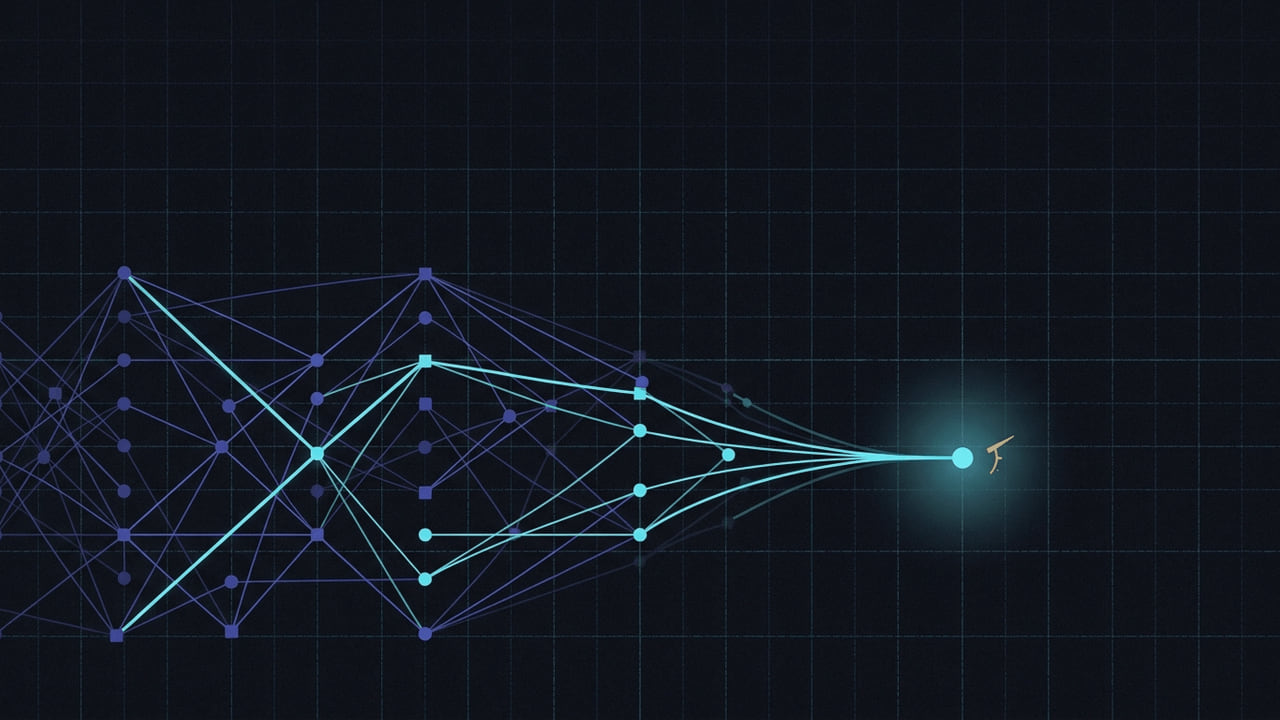
The calculus of association: formal structure on the left, where the strongest agreements brighten and converge into one grounded answer on the right.
The illustrated formal white paper frames Calyx as an association-native database whose atomic record is a constellation: one input measured through many frozen lenses, kept in separate slots, grounded by anchors, and guarded by fail-closed trust boundaries. It then argues that the association-heavy workload naturally points toward neuromorphic and memory-near hardware while keeping provenance and verification on a bit-exact digital spine.
Two coupled ideas: the minimal grounding kernel — the roughly one percent of records whose meaning explains an entire corpus — and the Oracle, a consequence predictor that builds a butterfly tree of downstream effects and walks it in reverse. The paper's central discipline is the honesty gate: the Oracle answers only when the measured panel bits meet or exceed the anchor entropy, so prediction is grounded in what the system can actually support rather than in fluent guessing.
A thesis about epistemic symmetry between questions and answers: when asking becomes as cheap as answering, the scarce, valuable thing shifts to the question side — good questions, judgment, and the grounding that tells a true answer from a fluent one. The paper reframes value around the asker, and ties that reframing to grounded retrieval and the Socratic shape of how the platform teaches.
UTML models learning itself as a small set of factors — ΔP, ΔK, ΔΩ, ΔΞ — describing a move from entropy toward coherence. It is the learning theory the platform's own pedagogy engine is built on: the predict-reveal-explain loop, knowledge tracing, and spaced review are instances of UTML's account of how a learner's understanding becomes more coherent over time.
Intelligence framed as the measured calculus of association: a system that stores meaning as a constellation seen through many independent lenses, and operates on it through four first-class verbs — Measure, Count, Differentiate, Compose. The paper makes the case that association, made measurable and never flattened, is the operation underneath retrieval, reasoning, and grounding, and sketches why that calculus is a candidate substrate for general intelligence.
We use necessary cookies to run this site. With your consent we also use privacy-friendly, first-party measurement — no third-party ad trackers. You can change this anytime from “Cookie preferences” in the footer. See our Privacy Policy.